
Squads & teams#
Guards that tell each other what they see, call in what they hear, split up the roles in a fight, and know who is on which side.
- Give AI the same Squad ID and they share what they see, within
Squad Share Range. - A guard that was told knows it: Stimulus is Shared Intel, so it can check rather than shoot.
- Request Combat Role splits a fight (one flanker, one suppressor) with no squad manager.
Squads#
Join a squad#
A squad is just a matching name. Call Set Squad ID on each AI's APS Core (at Begin Play):
Event Begin Play
└─► APS Core → Set Squad ID ("Patrol_A")Every AI with Patrol_A is a squadmate. Change it while playing to move an AI to another squad; None takes it out of any squad, and turns every squad feature off for it.
Sharing what it sees#
| Setting (Brain › Squad) | Default | What it does |
|---|---|---|
Squad Share Range | 3000 | How far, in cm, a share reaches: the squad's radio range |
Min Threat to Share | Low | The least threat level before it shares |
Auto Share on Detect | On | Share by itself when a target is Detected |
Auto Share on Track | Off | Share at Tracked instead (only when share on detect is off) |
Share on detect = a horde. One zombie sees you, the pack converges: infected, wolves, insects. Both off = discipline. Nothing is shared until you call Share Target with Squad: after a radio animation, a "contact!" bark, or only once the call-out is finished. That is what makes soldiers feel disciplined rather than telepathic.
| Node | Sends | For |
|---|---|---|
| Share Target with Squad (Target) | Everything it believes about the target: position, confidence, threat, velocity, cover | "Confirmed contact, here's everything" |
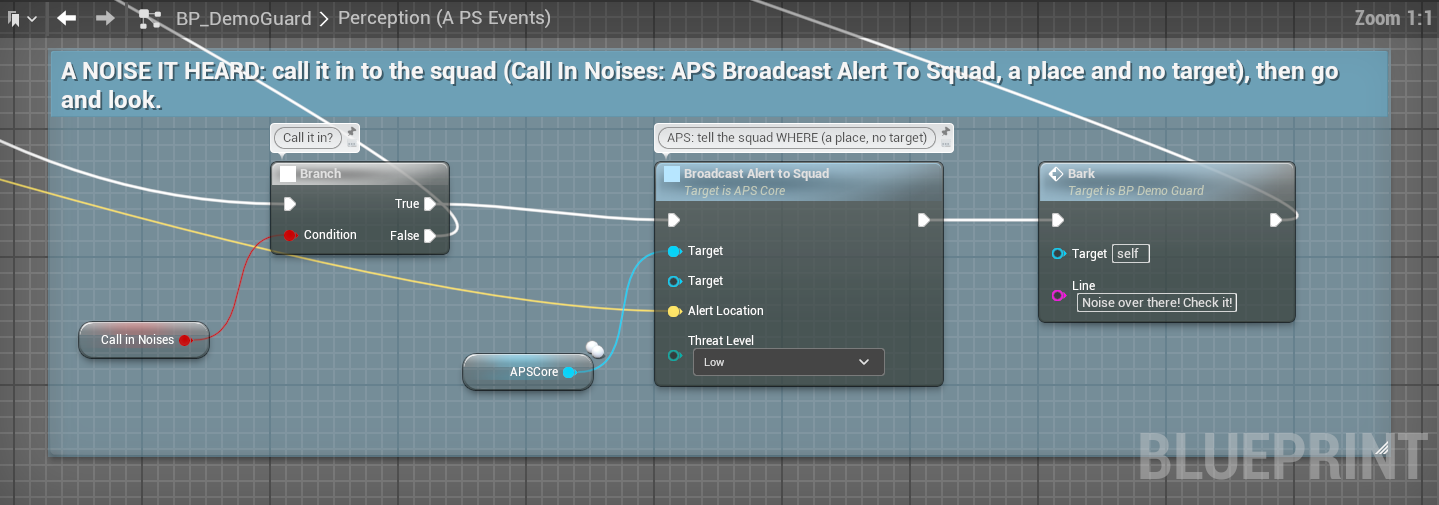
| Broadcast Alert to Squad (Target, Alert Location, Threat Level) | A place and a threat level, no target needed | "I heard something over there" |
Go deeperWhat a squadmate receives
Share Target with Squad writes into the receiver's belief:
- Position, predicted position and velocity are always replaced: shared intel is taken as fresher.
- Cover is copied if the sender saw the target take cover.
- Confidence is raised to the higher of the sender's confidence and the receiver's
Suspect Threshold, only if that is higher than what it already believes: it never lowers direct sensing. - Threat takes the higher of the two; the relationship is copied.
On AI Squad Alert fires on the receiver only when the news is new: the target was Undetected or Expired, or the shared threat is higher than what it had. Sharing the same target again doesn't fire it again, so auto-share is safe to leave on. Things (APS Evidence) are never shared.
It knows it was only told#
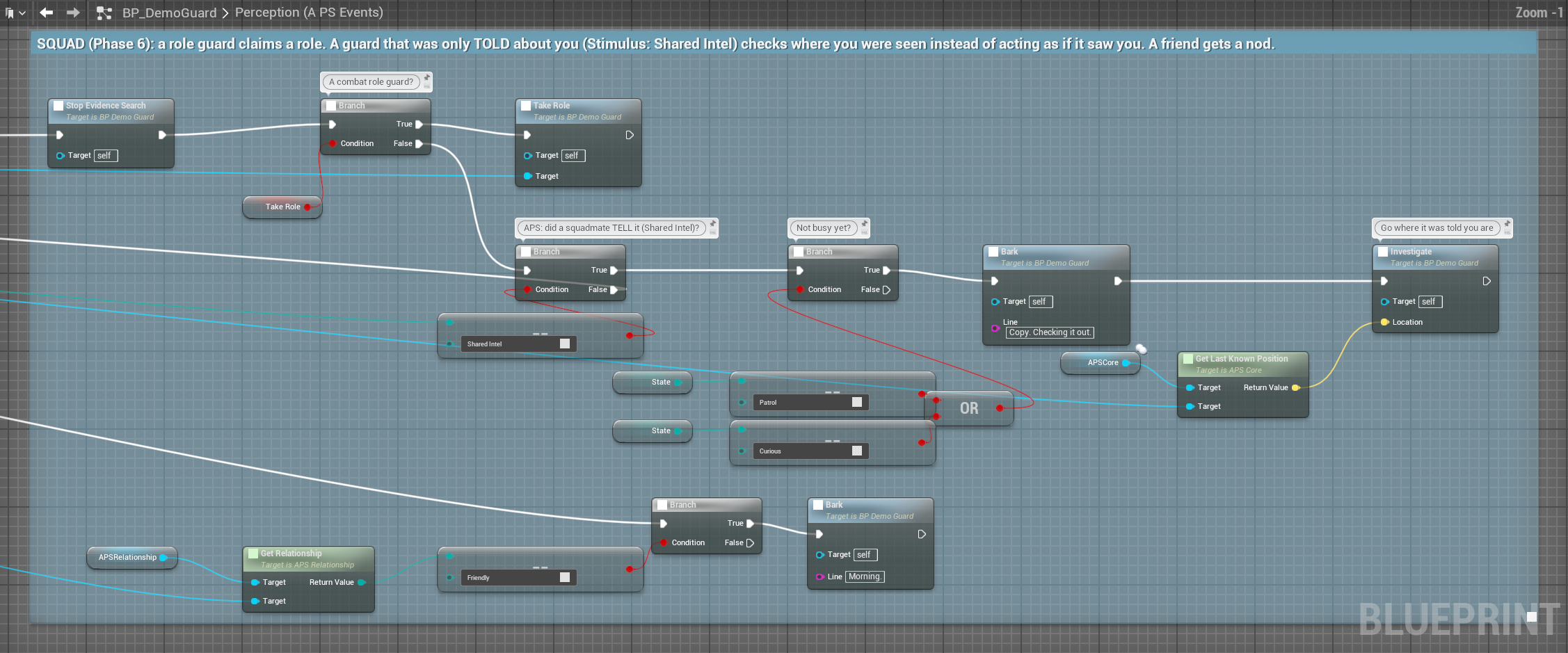
Shared intel arrives with Stimulus = Shared Intel on On AI Suspect and On AI Detect, so the receiver knows it didn't perceive this itself:
On AI Detect (Target, Threat Level, Stimulus)
  └─► Branch: Stimulus is Shared Intel
        True  → move up carefully, don't shoot yet
False → I saw this myself: engageThat one branch is the difference between a squad that converges sensibly and one that headshots you through a wall the instant anyone sees you.
Combat roles#
Each role is held by one squad member at a time: Approacher, Flanker, Suppressor, Investigator, Support (or None).
| Node | What it does |
|---|---|
| Request Combat Role (Role) | Claim it. False if a squadmate holds it, the AI is in no squad, or the role isn't in the profile's Eligible Roles. Claiming gives up the role it held before. |
| Release Combat Role | Give it back: when it dies, retreats or loses the target |
| Get Combat Role | What it holds |
| On Combat Role Assigned (Role) | Fires when a role is granted |
Eligible Roles on the profile limits what a kind of AI may claim: a heavy gunner can be Suppressor or Approacher, never Flanker. Empty means any role.
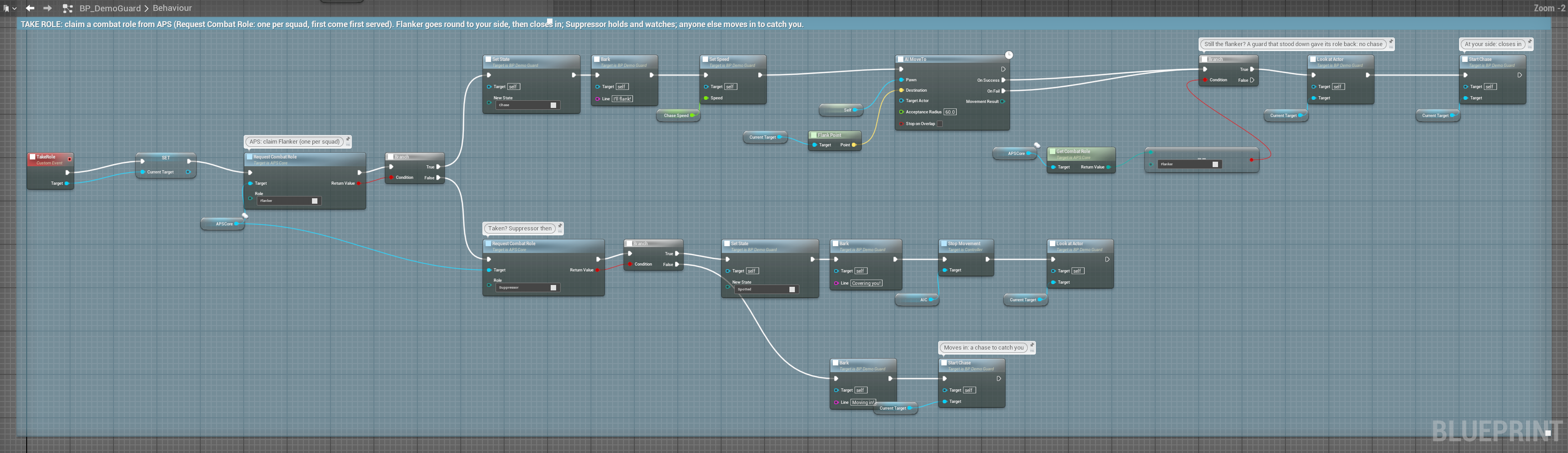
On AI Detect
  └─► Request Combat Role (Flanker)
        True  → Blackboard "Role" = Flanker       (the tree runs the flank)
        False → Request Combat Role (Suppressor)
                  True  → "Role" = Suppressor
                  False → "Role" = Approacher

On AI Forget
└─► Release Combat RoleFour guards spotting you now produce one flanker, one suppressor and two approachers, with no squad manager and no central coordinator.
Teams and relationships#
Add APS Relationship to the AI, next to its APS Core. It's optional: without it, everyone is Unknown.
| Setting | What it does |
|---|---|
Team Relationships | A team id (Unreal's Generic Team Id, from the target or its controller) → relationship |
Class Relationships | An actor class → relationship. Wins over teams. |
Default Relationship | When no rule matches |
The relationship is resolved in this order: Set Relationship Override (one actor, at runtime) → class → team → default. Get Relationship (Target) reads it.
| Relationship | Meaning | Its threat weight |
|---|---|---|
| Enemy | Hostile | 1 |
| High Value | A priority target: a VIP, an objective carrier | 1.2 |
| Feared | Something it should run from | 1.5 (the most) |
| Neutral | Civilians, wildlife: perceived, not threatening | 0.3 |
| Friendly | An allied faction, not this squad | 0: never a threat |
| Teammate | Its own side | 0: never a threat |
| Unknown | No rule matched | 0.5 |
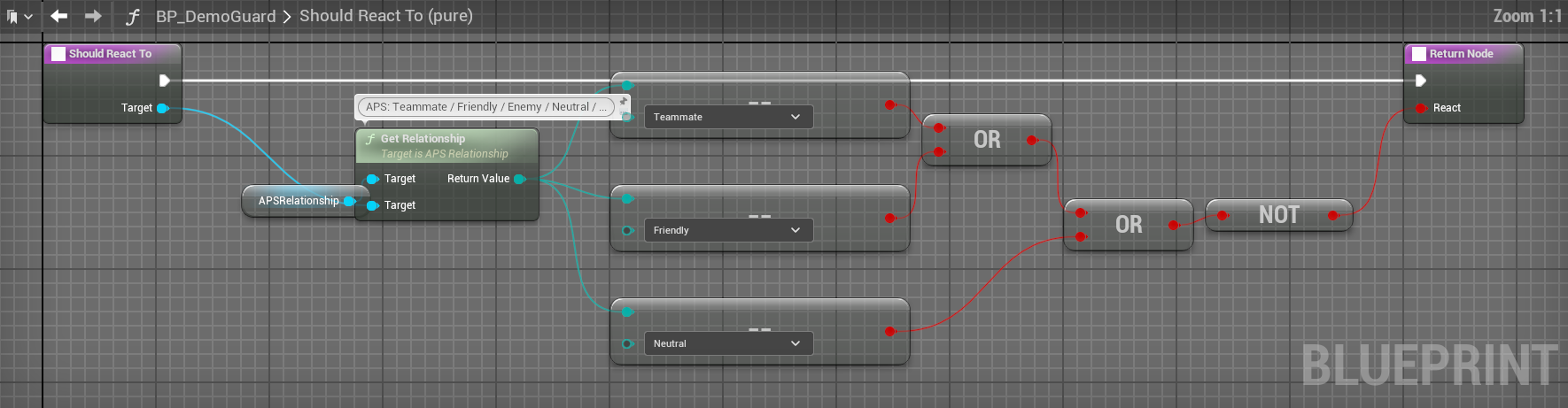
Relationships feed the threat score (Threat Weight Relationship), and Friendly and Teammate targets are never a threat however sure the AI is. They are also the cleanest branch in your behaviour:
On AI Detect (Target)
  └─► Switch on Get Relationship (Target)
        ├─ Enemy      → engage
        ├─ Feared     → flee (Set Fear Input 1 makes it afraid)
        ├─ High Value → call it in, go for it first
        ├─ Neutral    → ignore, keep patrolling
└─ Teammate → ignoreSet Relationship Override handles what a static rule can't: the player in a guard's uniform → Friendly; the disguise blown → Enemy; an NPC recruited mid-mission → Teammate; a boss enraged → the player Feared by nearby minions.
Debugging a squad#
The APS › Debug › Squad nodes return a report as text (one line per finding) and write it to the Output Log; show it with a Print String. To watch a squad live, the Visualizer's Squad page shows the squad of the AI in focus.
| Node | What it does |
|---|---|
| Squad State Report (Agent) | Squad id, every member, their distance, whether they're in share range, their role |
| Trace Squad Share Path (Sender, Target) | A dry run, step by step: squad id set, belief held, threat high enough, members registered, each in range. Nothing is shared. Start here when sharing doesn't work. |
| Squad Beliefs Report (Agent, Target) | What every member believes about one target: run it after a share |
| Simulate Squad Share (Sender, Target, Receiver) | Hand the sender's belief to one receiver, as a share would |
| Simulate Squad Alert (Receiver, Target, Location, Threat) | Fire On AI Squad Alert on one AI alone, to test its response |
| Force Full Squad Share (Sender, Target) | Share with every member, ignoring range and minimum threat |
APS and Unreal's AI Perception#
| Unreal AI Perception | APS | |
|---|---|---|
| Sharing | Each AI's eyes are its own | Squads share within radio range; noises can be called in |
| Knowing it was told | n/a | Stimulus: Shared Intel |
| Roles | None | Exclusive combat roles per squad |
| Teams | Generic Team Id: friendly, neutral, hostile | Classes, teams, per-actor overrides, seven relationships that feed threat |