
Knowledge & witnesses#
Knowledge that outlives the guard who saw you: descriptions a witness can give, reports that arrive late and vague over the radio, and a faction that hunts for whoever fits.
- Give the player an APS Signature: traits a witness could describe (an orange suit, a white van).
- Give guards an APS Observer: they report what they see to their faction, as a description.
- The faction's knowledge outlives the guard, and Match Descriptor asks who fits it. Change your coat and you stop fitting.
Descriptions: knowing of someone#
A descriptor is a set of traits, what a witness could describe:
| Field | Meaning |
|---|---|
Key | What kind of trait: ShirtColour, Vehicle, Height |
Value | What it is: Red, WhiteVan, Tall |
Observability | How easy it is to notice, 0 to 1 (0.8 by default) |
Put an APS Signature component on anything that can be described and fill its Signature; it comes with a starter set so it does something the moment it's added. A player who changes coat calls Set Trait again; one who ditches the car calls Remove Trait.
A better look sees more#
Get Observed Subset (Observation Quality) returns only the traits a witness could make out with a look that good: a trait is noticed when its Observability is at least 1 minus the quality. A close, clear look gets everything; a glimpse in the dark gets only the obvious. That is what makes a disguise a mechanic rather than a flag: change the loud trait and descriptions stop matching, though nobody checked a "disguised" box.
Does this person fit?#
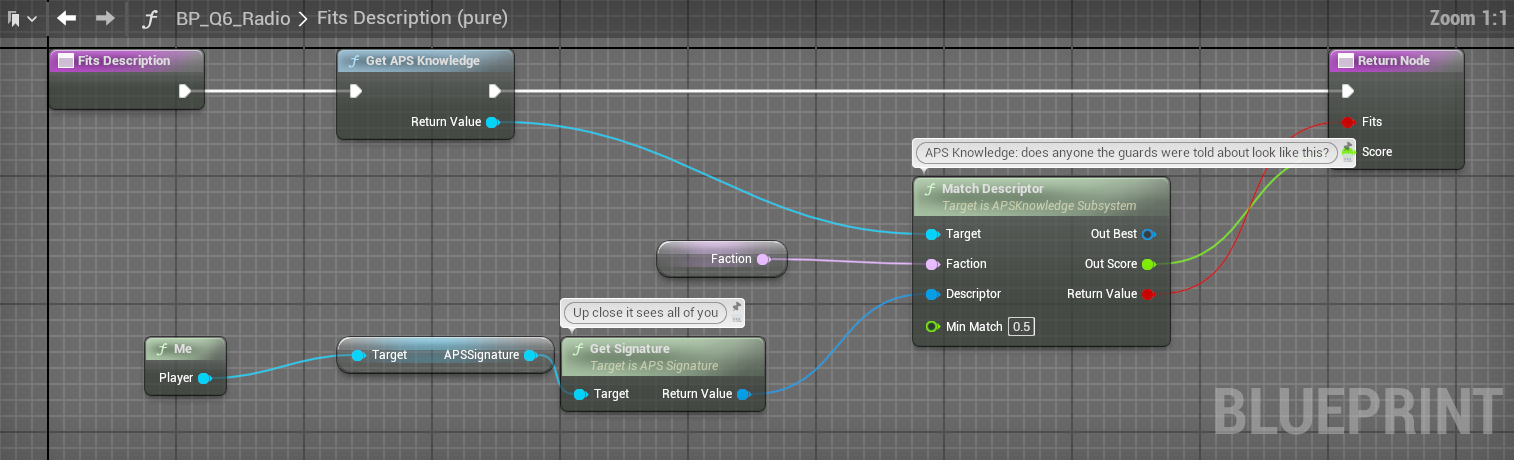
Match Descriptor (Faction, Descriptor, Min Match) asks the faction does anyone we know of look like this? and returns the best match and how well it fits:
- Only keys in both descriptions are compared: a witness who never saw the car doesn't weaken the match.
- Agreement is weighted by
Observability: matching on something unmissable counts for more than on a detail nobody could reliably see. - Each contradiction halves what is left (same key, a different value). Someone in a red shirt isn't a partial match for a blue-shirt suspect: they're actively less likely to be them.
| Node (any Blueprint) | What it does |
|---|---|
| Set Descriptor Trait (Descriptor, Key, Value, Observability) | Add a trait, or change one already there |
| Remove Descriptor Trait (Descriptor, Key) | Drop a trait |
| Get Descriptor Trait (Descriptor, Key) | What it says about a key; false when nothing |
| Match Against (Description, Known) | The 0 to 1 fit between any two descriptions |
| Shared Key Count (Descriptor, Other) | How many keys both have: a confident match on one trait is not a confident match on five |
What a faction knows#
The APS Knowledge subsystem keeps a store per faction: entries about people, each saying who reported it. Get it from any Blueprint with Get APS Knowledge.
| Node | What it does |
|---|---|
| Report Observation (Faction, Subject, Descriptor, Location, Confidence, Provenance) | Tell a faction something, at once. Merges with an entry about the same person, so ten sightings stay one manhunt. Returns the entry's id. |
| Report Via Channel (… Channel) | The same, sent along a channel: it arrives late, vaguer and missing details |
| Get Entry for Subject (Faction, Subject) | What the faction knows about one actor |
| Get Entries (Faction) | Everything it believes, strongest first |
| Match Descriptor | Who fits this description? |
| Cancel Pending From (Provenance) | Drop everything a sender has in flight: silence the witness before the message lands |
| Forget Entry, Forget Faction | Drop one entry, or everything a faction knows |
Every entry fades unless refreshed (Entry Decay Per Second) and is dropped below Entry Forget Threshold. On Knowledge Updated (Faction, Entry Id) fires when a report arrives.
Provenance is the point: every entry records who said so. That is what makes Cancel Pending From meaningful: take out a radio operator mid-transmission and the alert genuinely never arrives.
Channels: being told isn't seeing#
| Channel | Delay | Position error | Detail lost | Confidence |
|---|---|---|---|---|
| Direct (seen first-hand) | 0 s | 0 cm | none | × 1.00 |
| Shout | 0.5 s | up to 3 m | 25% | × 0.85 |
| Radio | 2 s | up to 6 m | 35% | × 0.75 |
| Report (in person) | 8 s | up to 15 m | 55% | × 0.60 |
Read a row: a report carried back on foot arrives eight seconds late, 15 m out, missing over half its detail, and believed a good deal less. That gap is where the drama is. A guard who got a clear look but could only shout passes on a description with a quarter of it missing, so the dragnet looks for the wrong coat, and the player gets away with something a working radio wouldn't have allowed. The channel specs are data on the subsystem: adjust them per project.
The faction's alert level#
Each faction has an alert, 0 to 1: a generalised wanted level. Reports raise it (Alert Per Report on the Observer); it decays over time. Get Faction Alert, Raise Faction Alert, Set Faction Alert, and On Faction Alert Changed (Faction, Alert).
The Observer: a guard that reports#
Add an APS Observer next to a guard's APS Core and it reports what that guard perceives to its faction, by itself:
| Setting | Default | What it does |
|---|---|---|
Faction | Police | Which faction it reports to |
Report Channel | Radio | How its reports travel: Direct is instant and complete; the others cost time and detail, and can be cut off |
Min Confidence to Report | 0.45 | Below this, not worth telling anyone |
Report Interval | 2 | Seconds between reports |
Ideal Observation Range | 600 | Closer than this is a perfect look |
Max Observation Range | 4000 | Further than this, nothing useful is made out |
Alert Per Report | 0.15 | How much each report raises the faction's alert |
Discover Evidence | On | Also find evidence near it |
Report Evidence to Faction | On | File what it finds with the faction too (off keeps it to itself) |
Get Observation Quality (Target) is how good a look it has right now: exactly what Get Observed Subset wants. Report Now files at once, ignoring the interval and confidence gates (an alarm pull, a phone call).
A report names the person only when the look is good (quality 0.75 or more). Below that, the faction gets a description and no actor: what a manhunt really starts from. The position reported is where the guard believes the person is, not where they really are, so a guard that only heard someone can't cheat for the faction.
Worked example: a description that degrades#
- The player, in a red coat, is seen at 35 m, near the edge of useful range: a poor look.
- Get Observed Subset at that quality keeps only the loud traits: the coat makes it, the watch doesn't.
- The guard has no radio, so your logic sends it with Report Via Channel, Shout: a quarter of the traits lost, the position up to 3 m out, confidence × 0.85.
- The faction now believes someone in a red coat, roughly there.
- The player takes off the coat (Remove Trait). The faction's description has nothing left to compare it with, so Match Descriptor finds no match and they walk past the dragnet. Swapping it for a blue coat (Set Trait Coat, Blue) works too: that key now contradicts, and with nothing else agreeing the match is 0.
Nothing there is a disguise system: it's look quality, channel loss and trait matching doing their ordinary jobs.
APS and Unreal's AI Perception#
| Unreal AI Perception | APS Knowledge | |
|---|---|---|
| Knowledge beyond one AI | None | Per faction, outliving the witness |
| Describing someone | None | Traits, noticed according to the look |
| Passing it on | n/a | Channels with delay, error and loss, that can be cut off |
| Recognising someone | Only by seeing them | By description: disguises work |